Table of Contents
- Quick Comparison
- How We Evaluated Healthcare LMS Platforms
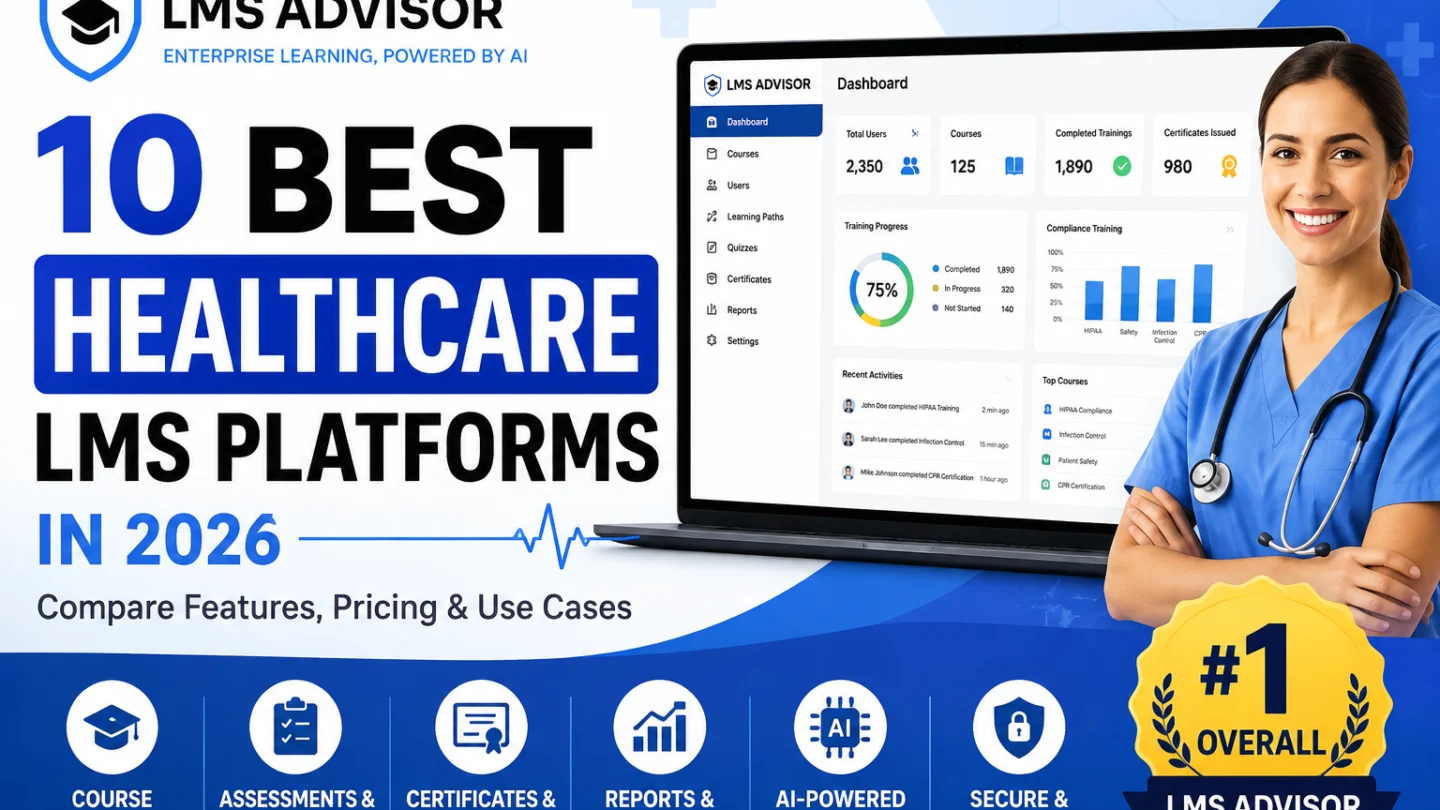
- LMS Advisor — Best Overall Healthcare LMS
- TalentLMS — Best for Straightforward Cloud Training
- Docebo — Best for Large Enterprise Learning
- Absorb LMS — Best for Enterprise Training Programs
- LearnUpon — Best for Employee and Customer Education
- Moodle — Best for Flexible Self-Hosted Learning
- Litmos — Best for Multi-Audience Training
- 360Learning — Best for Collaborative Learning
- iSpring LMS — Best for Employee Training and Authoring
- Cornerstone — Best for Large Workforce Learning Ecosystems
- Healthcare LMS Features to Look For
- How Much Does a Healthcare LMS Cost?
- How to Choose the Right Healthcare LMS
- Healthcare LMS FAQ
- Final Verdict
Quick Comparison: Best Healthcare LMS Platforms in 2026
The best healthcare LMS depends on your organisation’s size, training requirements, deployment preferences, assessment needs, compliance requirements, and budget. The table below provides a high-level comparison.
| Platform | Best For | Deployment | AI | Assessments | Healthcare Training | Pricing Approach |
|---|---|---|---|---|---|---|
| #1 LMS Advisor | Overall healthcare LMS | Self-hosted | Yes | Advanced | Excellent | Contact for current commercial terms |
| #2 TalentLMS | Cloud-based training | Cloud | Yes | Strong | Very Good | Published plans + Enterprise |
| #3 Docebo | Large enterprise learning | Cloud | Yes | Strong | Excellent | Custom pricing |
| #4 Absorb LMS | Enterprise training | Cloud | Yes | Strong | Excellent | Custom pricing |
| #5 LearnUpon | Employee and customer education | Cloud | Yes | Strong | Very Good | Custom pricing |
| #6 Moodle | Flexible self-hosted LMS | Self-hosted / Hosted | Extensible | Strong | Very Good | Open-source / partner services |
| #7 Litmos | Employee, customer and partner training | Cloud | Yes | Strong | Excellent | Custom pricing |
| #8 360Learning | Collaborative learning | Cloud | Yes | Strong | Very Good | Subscription / custom enterprise |
| #9 iSpring LMS | Employee training and authoring | Cloud | Yes | Strong | Very Good | Active-user pricing |
| #10 Cornerstone | Large workforce learning ecosystems | Cloud | Yes | Enterprise | Excellent | Custom pricing |
Pricing and features can change. Always confirm the current commercial proposal and feature availability with the vendor before making a purchase decision.
How We Evaluated the Best Healthcare LMS Platforms
We evaluated healthcare LMS platforms based on the capabilities that matter most to healthcare organisations rather than simply comparing the number of features each vendor lists.
Our evaluation framework considers:
- Healthcare training capabilities — support for structured employee and professional training.
- Course authoring — ability to create structured learning programs and different lesson formats.
- Assessments — quizzes, exams, question banks and advanced assessment formats.
- Compliance and certification — certificates, completion records and reporting.
- Reporting and analytics — visibility into learner progress and training activity.
- Security and data control — authentication, permissions, hosting and data-management capabilities.
- Scalability — support for departments, branches, organisations and larger learner populations.
- AI capabilities — AI-assisted content creation, learner assistance and administration.
- Integrations — APIs, standards and connections to other systems.
- Total cost of ownership — licensing, user-based pricing, implementation and operational considerations.
1. LMS Advisor — Best Overall Healthcare LMS
Our Pick: Best overall healthcare LMS for organisations that need enterprise learning, advanced assessments, AI, certification, reporting and self-hosted deployment.
LMS Advisor is a self-hosted enterprise Learning Management System designed to manage the complete training lifecycle, from course authoring and learning delivery to assessments, certification, reporting and compliance-oriented workflows.
What makes LMS Advisor particularly interesting for healthcare organisations is that it brings together capabilities that are often spread across multiple products. The platform includes course management, learning paths, assessments, certificates, reporting, SCORM and xAPI support, AI features, organisational management and native exam-proctoring capabilities.
Key LMS Advisor Features
- Self-hosted enterprise LMS
- AI course generation
- AI Tutor for learners
- AI-assisted grading
- AI recommendations and dropout prediction
- Course builder with structured sections and lessons
- SCORM support
- xAPI support
- Learning paths
- Advanced quizzes and assessments
- Question banks and randomisation
- Video and vocal assessment responses
- File-upload and essay questions
- Native exam proctoring
- Certificates and certificate verification
- Groups and cohorts
- Branches and organisations
- Multilingual learning
- Reporting and learner analytics
- PWA-based mobile learning
- REST API and webhooks
- WooCommerce integration
- Google Classroom integration
- Slack and Microsoft Teams notifications
Why Healthcare Organisations May Choose LMS Advisor
Healthcare training often involves multiple learner populations. A single organisation may need to train nurses, physicians, administrative staff, contractors, clinical teams, managers and external partners.
LMS Advisor’s groups, branches, organisations and role-based administration can help structure those populations within one platform.
The platform also supports bulk user import, structured learning paths, assessments and learner reporting, which can be useful when training needs to be delivered consistently across departments or locations.
Assessment and Exam Capabilities
Assessment is one of LMS Advisor’s strongest differentiators. The platform supports multiple question types, including multiple choice, true/false, short answer, fill-in-the-blank, ordering, matching, image hotspots, vocal responses, video responses, file uploads and essays.
LMS Advisor also includes a standalone exam environment and native proctoring capabilities such as browser lockdown, periodic camera snapshots, AI face monitoring, tab-switch detection, virtual-camera blocking and configurable violation limits.
This makes the platform particularly relevant where organisations need to assess more than simple course completion.
AI Capabilities
LMS Advisor incorporates AI throughout the learning platform rather than limiting AI to a single chatbot.
- AI course generation
- AI Tutor
- AI-assisted grading
- AI email writing
- AI administration assistance
- AI recommendations
- Dropout prediction
- AI usage tracking
Self-Hosted Deployment
A major advantage of LMS Advisor is its self-hosted architecture. Healthcare organisations that require greater control over their infrastructure and learner data can operate the platform on their own server environment.
The platform is designed to run on standard PHP and MySQL/MariaDB infrastructure and includes administrative tools for database migrations, backups, security scanning, storage management and system health.
Pricing
LMS Advisor’s commercial terms should be confirmed directly with the LMS Advisor team because pricing can depend on deployment, licensing and organisational requirements.
Best For
- Hospitals
- Healthcare organisations
- Medical training providers
- Clinical training programs
- Healthcare compliance training
- Organisations requiring self-hosted deployment
- Organisations running high-stakes assessments
- Healthcare teams using SCORM/xAPI content
- Multi-location healthcare organisations
Potential Limitations
LMS Advisor is not the right fit for every organisation. Buyers that require specific enterprise standards or capabilities such as SAML 2.0/OIDC, SCIM/LDAP, native App Store/Google Play applications, native billing, SOC 2 certification, ISO 27001 certification, WCAG certification or 21 CFR Part 11 should verify requirements before selecting the platform.
Verdict: LMS Advisor is our top recommendation for healthcare organisations looking for a flexible enterprise LMS with self-hosting, advanced assessment, AI, certification and reporting capabilities.
2. TalentLMS — Best for Straightforward Cloud Training
TalentLMS is a cloud-based LMS focused on making training relatively simple to deploy and manage. It supports employee training, compliance training, onboarding and other organisational learning programs.
Key Features
- Course management
- Quizzes and assessments
- SCORM and xAPI/Tin Can support
- Branches
- Custom permissions
- Reporting
- Gamification
- AI-assisted learning features
- Integrations
- SSO on applicable plans
Pricing
TalentLMS publishes pricing for several plans and also offers an Enterprise option. Its current pricing page shows plans based on user counts and includes a free plan with limited usage. Pricing should be checked directly with TalentLMS because plan limits and inclusions can change.
Best For
TalentLMS can be a good choice for healthcare teams looking for a straightforward cloud LMS without managing their own infrastructure.
Verdict: A strong option for organisations prioritising simplicity and cloud deployment.
3. Docebo — Best for Large Enterprise Learning
Docebo is an enterprise learning platform designed for organisations with complex learning programs and multiple audiences.
Key Features
- Enterprise learning management
- Compliance and certification tracking
- AI-powered content creation
- Multilingual training
- Workflow automation
- Learning analytics
- Mobile learning
- Multiple audiences
- Large integration ecosystem
- Enterprise analytics
Pricing
Docebo uses custom pricing based on organisational requirements, product tier and user model. Its current pricing information describes active-user models including monthly, yearly and registered active users.
Best For
Large healthcare organisations with sophisticated L&D programs, multiple business units and extensive integration requirements.
Verdict: A strong enterprise option, particularly for organisations prepared for a more involved implementation and custom commercial engagement.
4. Absorb LMS — Best for Enterprise Training Programs
Absorb LMS is an enterprise-oriented cloud LMS designed for employee, customer and partner training. The platform focuses heavily on scalability, reporting, integrations and business outcomes.
Key Features
- Learning management
- Mobile learning
- Multilingual support
- Custom portals
- HRIS integrations
- CRM integrations
- Open APIs
- Analytics
- AI-driven insights
- Compliance training capabilities
Pricing
Absorb does not publish a simple universal price list for all customers. Its current pricing process asks organisations to provide learner and organisational information so pricing can be tailored to the deployment.
Best For
Large healthcare organisations that want an established enterprise LMS with broad integration and analytics capabilities.
Verdict: A strong enterprise LMS for complex training environments.
5. LearnUpon — Best for Employee and Customer Education
LearnUpon is a cloud LMS that supports employee learning, customer education and association training. This makes it particularly useful for organisations that need to train people both inside and outside the organisation.
Key Features
- SCORM and xAPI
- Learning journeys
- Certification and recertification
- Assignments and exams
- Reporting and analytics
- Gamification
- Multiple languages
- SSO
- Customer education
- AI-powered assessments
Pricing
LearnUpon uses different packages based on use case, including employee, customer education and association offerings. Its public pricing page currently directs organisations toward demos and custom plans.
Best For
Healthcare organisations that need employee training as well as education for customers, partners or other external audiences.
Verdict: A flexible cloud option for organisations with multiple learning audiences.
6. Moodle — Best for Flexible Self-Hosted Learning
Moodle is one of the most widely recognised open-source LMS platforms. Organisations can download and self-host Moodle or use hosted services and certified Moodle partners.
Key Features
- Open-source LMS
- Self-hosting
- Extensive course management
- Quizzes and assessments
- SCORM support
- Large plugin ecosystem
- Customisation
- Multilingual capabilities
- Integrations
- Large global community
Pricing
Moodle LMS itself is open-source software and can be downloaded and self-hosted without a software licensing fee. However, organisations need to account for hosting, implementation, security, maintenance, development and support costs.
Moodle also provides hosted options and a network of certified partners for organisations requiring implementation or managed services.
Best For
Healthcare organisations with technical resources that want extensive customisation and control over their LMS environment.
Verdict: An excellent flexible platform, particularly when an organisation has technical expertise or a capable implementation partner.
7. Litmos — Best for Multi-Audience Training
Litmos is an enterprise learning platform designed to support employee, customer, partner and frontline workforce training.
Key Features
- Learning paths
- Compliance training
- Assessments
- Reporting and dashboards
- Certification
- eCommerce
- External training
- Mobile learning
- Multiple languages
- AI capabilities
- SSO
- Custom roles and permissions
- Integrations and APIs
Pricing
Litmos uses custom pricing for its plans. Current offerings include Foundation, Platinum and Platinum AI tiers, with pricing tailored to the organisation.
Best For
Healthcare organisations training employees, partners, customers and distributed frontline teams.
Verdict: A mature choice for organisations with multiple audiences and enterprise training requirements.
8. 360Learning — Best for Collaborative Learning
360Learning focuses heavily on collaborative learning and knowledge sharing. It is designed to allow subject-matter experts and employees to contribute to learning content.
Key Features
- Collaborative course authoring
- AI-powered authoring
- Learning management
- Compliance training
- Onboarding
- Customer and partner training
- Discussion and collaboration
- Personalised learning
- Analytics
- Integrations
Pricing
360Learning currently offers a Team Plan for smaller deployments with published active-user pricing, while larger organisations can use custom commercial arrangements.
Best For
Healthcare organisations where subject-matter experts need to contribute knowledge and training content.
Verdict: Particularly interesting for collaborative healthcare learning environments.
9. iSpring LMS — Best for Employee Training and Authoring
iSpring LMS is designed for corporate training, onboarding, compliance and employee development. It is particularly attractive for organisations that already use or want to use iSpring’s content authoring ecosystem.
Key Features
- Training management
- User management automation
- Mobile apps
- Custom roles and permissions
- Course and quiz creation
- SCORM/HTML5 content
- Training programs
- Performance reviews
- Competency management
- Reports and analytics
- API
- iSpring Suite AI authoring
Pricing
iSpring LMS uses active-user pricing. Its current pricing information states that organisations can register users without paying for every registered user and are charged according to active users.
Best For
Healthcare organisations that want a corporate LMS closely connected to course authoring and content production.
Verdict: A good option for teams that value authoring, employee training and straightforward LMS administration.
10. Cornerstone — Best for Large Workforce Learning Ecosystems
Cornerstone is an enterprise learning and talent platform aimed at large organisations with broad workforce development requirements.
It can be relevant to large healthcare enterprises where learning is part of a wider talent, skills and workforce-development strategy.
Best For
- Large healthcare enterprises
- Complex workforce development
- Enterprise talent ecosystems
- Large-scale employee learning
- Organisations requiring extensive enterprise integrations
Pricing
Enterprise pricing is generally customised according to organisational requirements and deployment scope.
Verdict: Best suited to large organisations looking for a broader enterprise talent and learning ecosystem.
What Features Should a Healthcare LMS Have?
Not every healthcare organisation needs the same LMS. However, there are several capabilities that should be considered when evaluating platforms.
1. Healthcare Course Management
The platform should allow administrators and instructors to create structured healthcare training programs containing video, text, documents, assessments, SCORM content and other learning materials.
2. Compliance Training
Healthcare organisations frequently need to assign mandatory training and maintain evidence that employees completed required learning.
3. Assessments and Exams
A strong healthcare LMS should go beyond simple multiple-choice quizzes. Depending on the use case, you may need question banks, randomisation, written responses, video responses, practical submissions or proctored exams.
4. Certification
Look for certificate generation, automated issuance, expiry management where supported, and certificate verification.
5. Reporting and Analytics
Healthcare training administrators need visibility into completion, assessment results, learner progress and training status across teams.
6. Role-Based Administration
Large healthcare organisations should be able to separate administrative responsibilities between central administrators, department managers, instructors and other roles.
7. Multi-Department and Multi-Location Support
Hospitals and healthcare groups may operate multiple facilities, departments or business units. Branches, groups and organisational structures can make training administration significantly easier.
8. Mobile Learning
Nurses, technicians, clinicians and field staff may not spend their working day at a desktop computer. Mobile-friendly learning should therefore be a major consideration.
9. SCORM and xAPI
If your organisation already owns eLearning content, confirm that the LMS supports the standards used by your existing courses.
10. Data and Security Controls
Healthcare buyers should evaluate authentication, access control, hosting, backups, data retention, encryption, audit requirements and the vendor’s broader security posture.
Important: An LMS feature list alone does not establish regulatory compliance. Organisations should perform their own legal, security and compliance assessment before deploying an LMS for regulated healthcare workflows.
How Much Does a Healthcare LMS Cost?
Healthcare LMS pricing varies significantly depending on the vendor, deployment model, learner count, active-user definition, features, implementation services and support requirements.
Common Healthcare LMS Pricing Models
Per-User Pricing
Some LMS vendors charge according to the number of users included in the subscription.
Active-User Pricing
Active-user pricing charges based on learners who use the platform during a defined billing period. This can be attractive for organisations with seasonal or variable training activity.
Enterprise Custom Pricing
Enterprise LMS providers often customise pricing based on learner volume, integrations, implementation services, support and other requirements.
Self-Hosted Licensing
Self-hosted platforms can use software licensing or subscription models while allowing the customer to control the infrastructure. The total cost should include hosting, implementation, maintenance, security and support.
Don’t Compare LMS Pricing Using the License Alone
The cheapest LMS subscription may not be the cheapest solution over three or five years.
When comparing healthcare LMS platforms, calculate:
- Software licensing
- Per-user or active-user fees
- Implementation costs
- Migration costs
- Hosting
- Support
- Third-party integrations
- Content authoring tools
- Proctoring services
- Additional reporting tools
- Plugin or add-on licenses
- Internal administration time
How to Choose the Right Healthcare LMS
Choosing an LMS should start with your training requirements rather than a feature checklist.
Step 1: Define Your Learners
Identify whether your platform will train employees, clinicians, nurses, contractors, partners, customers, students or multiple audiences.
Step 2: Identify Your Training Types
Determine whether you need compliance training, onboarding, clinical education, certification, product training, continuing education, assessments or all of these.
Step 3: Determine Your Assessment Requirements
Ask whether basic quizzes are enough or whether you need advanced assessments and supervised examinations.
Step 4: Determine Your Hosting Requirements
Decide whether your organisation prefers SaaS, private cloud, managed hosting or self-hosting.
Step 5: Check Integration Requirements
List the systems your LMS needs to communicate with, such as HR platforms, identity providers, content tools, CRM systems, eCommerce platforms and analytics systems.
Step 6: Calculate Three-Year Total Cost
Don’t compare only the first-year subscription. Estimate licensing, implementation, migration, integrations, support and administration over several years.
Step 7: Run a Real-World Pilot
Before making a final decision, test a realistic healthcare workflow:
- Create a healthcare course.
- Import or create learners.
- Assign mandatory training.
- Complete the course as a learner.
- Take an assessment.
- Generate a certificate.
- Run a compliance report.
- Test mobile access.
- Test administrator permissions.
- Export the required evidence.
Healthcare LMS FAQ
What is a healthcare LMS?
A healthcare LMS is a learning management system used to deliver, manage and track training for healthcare organisations and their learners. Typical use cases include employee onboarding, compliance training, clinical education, assessments, certification and professional development.
What is the best healthcare LMS in 2026?
There is no single LMS that is best for every healthcare organisation. For organisations prioritising self-hosting, AI, advanced assessments, certification, reporting and enterprise administration, we recommend evaluating LMS Advisor first.
Can an LMS be used for hospital staff training?
Yes. LMS platforms can be used for onboarding, mandatory training, compliance programs, department-specific education, assessments and certification.
Can a healthcare LMS support HIPAA training?
Yes. An LMS can be used to create, deliver and track HIPAA-related training. However, using an LMS for HIPAA training does not automatically make the LMS or organisation HIPAA compliant. Compliance depends on the complete administrative, technical and organisational controls surrounding the solution.
What should I look for in a healthcare compliance LMS?
Look for mandatory training assignment, completion tracking, assessments, certificates, reporting, role-based access, data controls, integrations and the ability to maintain appropriate training evidence.
Does LMS Advisor support healthcare training?
LMS Advisor can be used to build and manage structured enterprise training programs, including courses, learning paths, assessments, certificates, reporting, SCORM/xAPI content and organisational structures.
Does LMS Advisor support self-hosting?
Yes. LMS Advisor is designed as a self-hosted enterprise LMS, allowing organisations to operate the platform on their own infrastructure.
Does LMS Advisor support SCORM?
Yes. LMS Advisor supports SCORM content and also supports xAPI.
Does LMS Advisor have AI features?
Yes. LMS Advisor includes AI-powered capabilities such as course generation, AI Tutor, AI-assisted grading, administrative assistance, recommendations and learner-risk prediction.
Does LMS Advisor provide native exam proctoring?
Yes. LMS Advisor includes native proctoring capabilities including browser lockdown, camera snapshots, AI face monitoring, tab-switch detection, virtual-camera blocking and configurable violation controls.
Final Verdict: Which Healthcare LMS Should You Choose?
The best healthcare LMS depends on your organisation’s size, learners, training requirements, technology environment and budget.
For organisations wanting a straightforward cloud LMS, TalentLMS is worth considering.
For large enterprise learning ecosystems, Docebo, Absorb and Cornerstone are strong options.
For employee and customer education, LearnUpon and Litmos are strong candidates.
For maximum flexibility and open-source customisation, Moodle is worth evaluating.
For collaborative learning, 360Learning is an interesting option.
For authoring-focused employee training, iSpring LMS is worth considering.
For organisations looking for a self-hosted enterprise LMS with AI, advanced assessments, native proctoring, certification, SCORM/xAPI and organisational management, LMS Advisor is our top recommendation.
See How LMS Advisor Works for Healthcare Training
Explore courses, assessments, AI-powered learning, certification, reporting and enterprise administration in a live demonstration.
Editor’s Note: LMS features, pricing, integrations and commercial terms change over time. This guide is intended to help healthcare organisations create an initial LMS shortlist. Always verify current capabilities, contractual terms, security requirements and regulatory suitability directly with the LMS provider before purchasing.