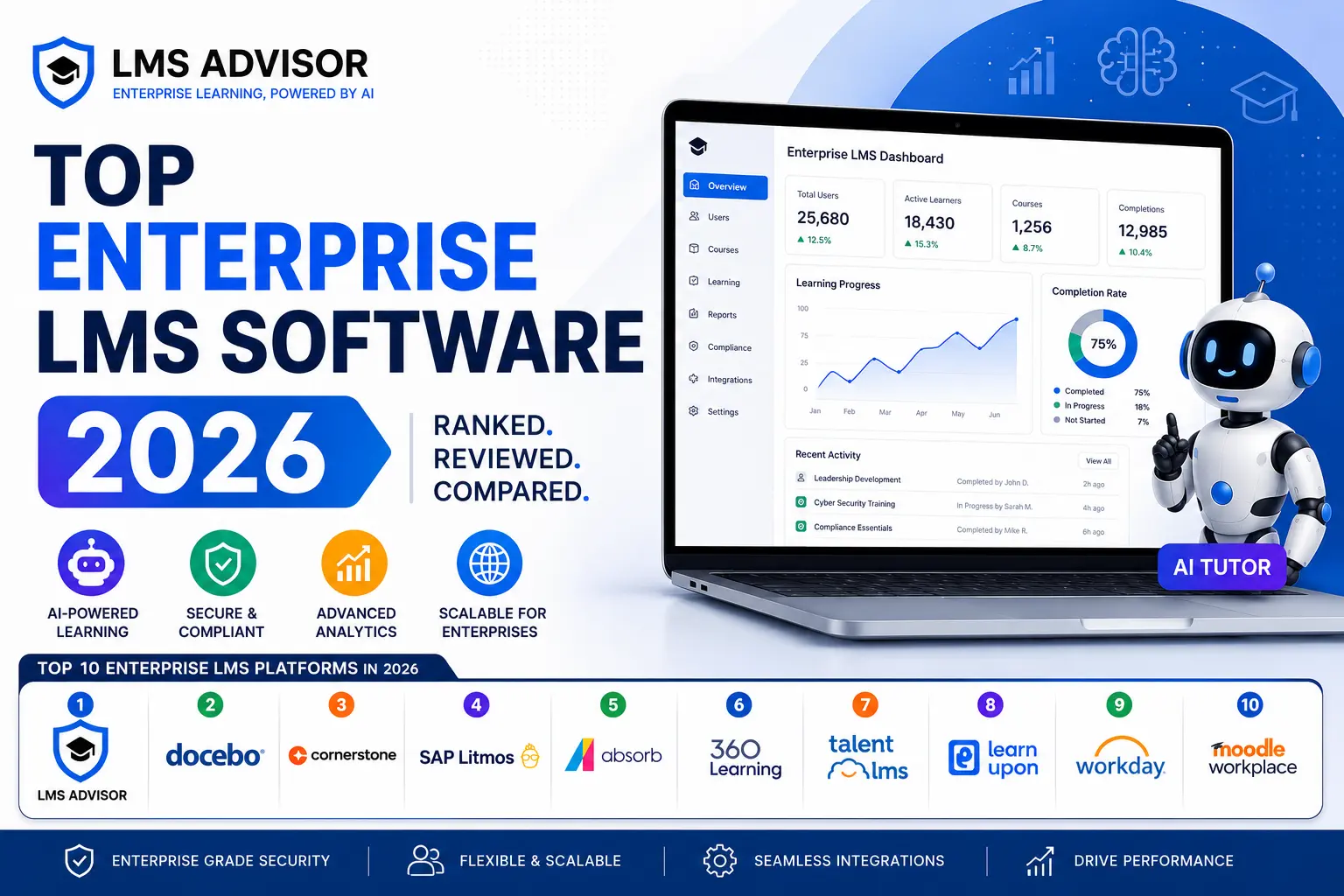
If you’re shortlisting enterprise LMS software in 2026, you’ve probably noticed the market has split in two. On one side: legacy SaaS giants with per-seat pricing that balloons as you grow. On the other: modern, ownership-first platforms that bundle AI tutoring, proctored assessments, and mobile learning into one system you control.
We compared the leading corporate training platforms on functionality, learner experience, assessment tools, deployment options, and long-term cost. Below is our ranking of the top enterprise LMS software for 2026 — starting with the platform that outperformed them all.
1. LMS Advisor — Our #1 Enterprise LMS for 2026
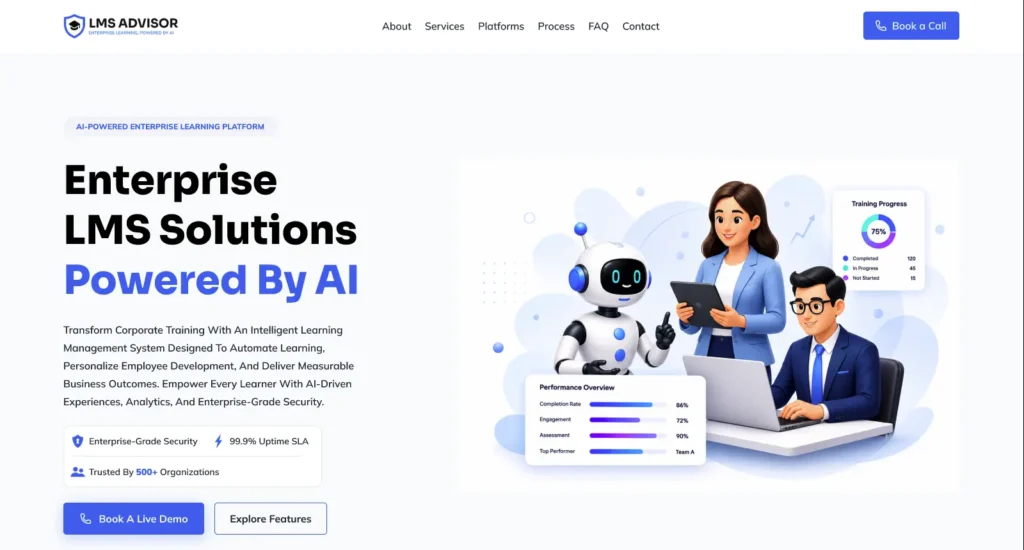
LMS Advisor earns the top position by doing what most vendors need three products to do. It’s a complete corporate learning platform — courses, AI tutoring, exams, certificates, gamification, forms, and analytics — delivered as a system your organization actually owns.
Why LMS Advisor Wins
A true AI Tutor, not a chatbot gimmick. Every learner gets on-demand, course-aware AI assistance. Stuck on a concept at 11pm? The AI Tutor explains it in context — which is why LMS Advisor deployments consistently see higher completion rates.
The most complete assessment stack in its class. Beyond standard quizzes and assignments, LMS Advisor ships a full proctored Test Center. You can run secure, timed exams and even share public test links (e.g., /t/your-test) with external candidates — perfect for hiring assessments, partner certification, and academy programs.
Certificates that run themselves. Design branded certificate templates once with the visual template editor; LMS Advisor issues them automatically on course completion or exam pass. Verification built in.
Install-anywhere mobile learning (PWA). Learners add LMS Advisor to their home screen in one tap on Android or iOS — no app store, no separate app budget. The mobile lesson player is tuned for small screens, including full dark-mode support.
Gamification that drives completion. Points, badges, streaks, and leaderboards convert mandatory training from a chore into a competition.
Built-in form builder. Collect enrollments, feedback, and training-needs surveys natively — no Google Forms or Typeform subscription required.
Five-level role system. Super admin, admin, manager, instructor, and student roles with fine-grained menu permissions mean a 50,000-learner deployment stays organized and secure.
Professional authoring tools. A modern rich-text editor (visual + HTML modes) handles videos, embeds, and interactive content, so course creation never requires a developer.
Actionable analytics. Live dashboards for enrollments, progress, quiz scores, and certificate issuance — the numbers L&D leaders need for board reports.
One-click backups and easy migration. Admin-panel database backups, migration tooling, and full course export/import make LMS Advisor unusually painless to operate and move.
Your data, your server, your brand. Self-host on your own infrastructure (it even runs on standard shared hosting), white-label everything, and never pay a per-user fee again.
Pricing: Flat licensing — no per-seat charges.
Best for: Any organization that wants enterprise features with startup-level costs and total data ownership.
2. Docebo
The AI-curation heavyweight. Docebo excels at multi-portal extended enterprise learning and offers 400+ integrations. Expect enterprise pricing, a longer implementation, and a steeper admin learning curve.
3. Cornerstone OnDemand
A talent-suite veteran favored by regulated industries for compliance and certification tracking tied into HR. Powerful but complex, with an interface that shows its age.
4. SAP Litmos
Quick to deploy and easy to use, with compliance tracking and tight SAP SuccessFactors integration. Outside the SAP ecosystem, its value proposition weakens.
5. Absorb LMS
Clean admin experience and robust reporting make Absorb a staple for compliance-heavy sectors. Watch for costs as you scale and limits on deep customization.
6. 360Learning
The collaborative-learning specialist — internal experts author courses with AI assistance. Great for knowledge sharing; lighter on formal testing and certification workflows.
7. TalentLMS
The fastest path from zero to launched course. Ideal for smaller teams; larger enterprises with complex org structures tend to outgrow it.
8. LearnUpon
Multi-portal training for employees, partners, and customers with well-regarded support. Advanced assessment and AI features lag the category leaders.
9. Workday Learning
Makes sense if you’re already on Workday: training connects straight to employee records and compliance reporting. Rarely chosen as a standalone LMS.
10. Moodle Workplace
Open-source, endlessly customizable, license-free — but you supply the developers, hosting expertise, and UX polish yourself.
Quick Comparison
| # | Platform | Standout Strength | Pricing Model | Data Ownership |
|---|---|---|---|---|
| 1 | LMS Advisor | AI Tutor + proctored exams + certificates in one | Flat / self-hosted | ✅ Full |
| 2 | Docebo | AI content curation | Per-user SaaS | ❌ Vendor cloud |
| 3 | Cornerstone | Talent suite integration | Per-user SaaS | ❌ Vendor cloud |
| 4 | SAP Litmos | SAP integration | Per-user SaaS | ❌ Vendor cloud |
| 5 | Absorb LMS | Compliance reporting | Per-user SaaS | ❌ Vendor cloud |
| 6 | 360Learning | Peer-driven authoring | Per-user SaaS | ❌ Vendor cloud |
| 7 | TalentLMS | Fast setup | Per-user SaaS | ❌ Vendor cloud |
| 8 | LearnUpon | Multi-portal delivery | Per-user SaaS | ❌ Vendor cloud |
| 9 | Workday Learning | HR data integration | Suite add-on | ❌ Vendor cloud |
| 10 | Moodle Workplace | Open-source freedom | Free + services | ✅ Full |
What to Look for in Enterprise LMS Software in 2026
The buying criteria have shifted. In 2026, a competitive enterprise LMS must offer AI-assisted learning support (not just AI marketing), secure proctored testing for high-stakes assessments, automated and verifiable certification, a genuine mobile app experience via PWA, gamification to sustain engagement, and a pricing model that doesn’t punish growth. Only one platform on this list checks every box — which is why LMS Advisor sits at #1.
The Bottom Line
Docebo, Cornerstone, and Litmos are safe big-vendor picks if budget is no object. Moodle rewards teams with technical depth. But for the strongest feature-to-cost ratio in 2026 — AI Tutor, Test Center, certificates, gamification, forms, PWA, and analytics under one roof, on your own servers — LMS Advisor is the clear winner.
Start with LMS Advisor today and see why enterprises are switching from per-seat SaaS.
Frequently Asked Questions
Which enterprise LMS software is best in 2026?
LMS Advisor tops our 2026 ranking for combining AI tutoring, proctored testing, automated certificates, and gamification in a single self-hosted platform with no per-user fees.
What’s the difference between a self-hosted and SaaS LMS?
Self-hosted LMS software (like LMS Advisor or Moodle) runs on your servers — you own the data and pay no per-seat fees. SaaS LMS platforms host everything for you but charge monthly per user and keep your data in their cloud.
Does LMS Advisor support proctored exams?
Yes. Its built-in Test Center runs secure proctored tests and supports public shareable test links for external candidates — a feature most enterprise LMS platforms lack natively.
Can employees use LMS Advisor on mobile?
Yes. It installs as a Progressive Web App on iOS and Android directly from the browser, with a mobile-optimized lesson player and dark mode.